
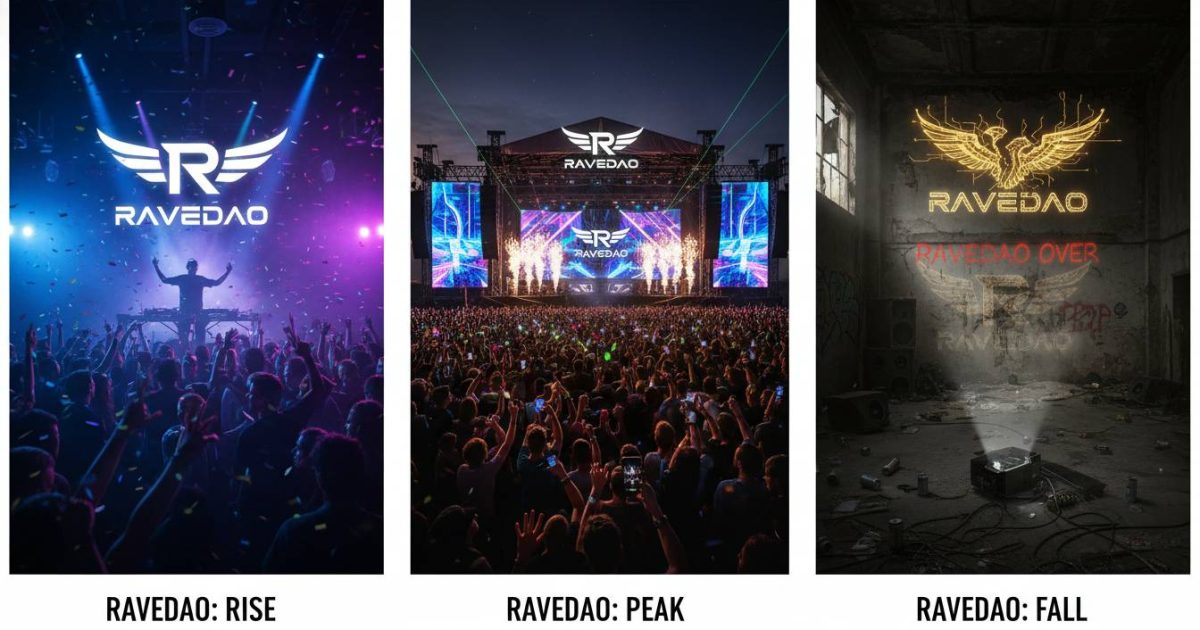
RaveDAO’s RAVE token became one of April 2026’s strangest crypto stories: a low-float coin that rocketed thousands of percent, drew manipulation scrutiny, and then collapsed hard enough to wipe out late buyers. The headline number was eye-catching, but the structure underneath mattered more. Public market data, exchange-linked flow reports, and token distribution figures all point to the same issue: when supply is concentrated and liquidity is thin, price can move far faster than fundamentals. That is exactly what happened here.
How RAVE Went From Obscure Token to a 10,000% Talking Point
RAVE did not become controversial because it merely rallied. Crypto sees violent rallies all the time. What made this case stand out was the combination of speed, float concentration, exchange activity, and the scale of the reversal. CoinMarketCap’s own market pages and related coverage show RAVE trading with a maximum supply of 1 billion tokens and a circulating supply around 239.17 million to 248.04 million tokens across snapshots captured in April 2026, implying that only about one quarter of total supply was circulating publicly. That matters because a token with roughly 24% circulating supply can be pushed around far more easily than one with broad distribution.
CoinMarketCap’s April 13, 2026 story said roughly 76% of the 1 billion token supply was locked in allocations and insider-controlled wallets, leaving an exceptionally thin tradable float. The same report tied a 41.57% hourly surge to coordinated squeeze mechanics rather than a fresh fundamental catalyst. Another CoinMarketCap top-stories item published the same week described RAVE as being up more than 226% in 24 hours at one point, while also citing team-linked transfers of about 18.58 million RAVE to exchanges. Those are not small details. They are the mechanics of a structurally fragile market.
The token’s public market profile also changed rapidly. CoinMarketCap snapshots indexed over the past week showed wildly different rankings and prices, including one page showing RAVE at $0.228, another showing a live price around $0.5756, and another localized page implying a much higher euro valuation in a separate snapshot. That inconsistency is not proof of wrongdoing by itself, but it does reflect how fast the market was moving and how difficult price discovery became during the frenzy. A Spanish-language CoinMarketCap conversion page crawled five days ago stated that RAVE had gained 4,474.06% against the U.S. dollar over 30 days. Other market commentary pushed the narrative even further, with some articles framing the move as a 4,000%-plus seven-day surge and social chatter stretching that into “10,000% gains.”
The project itself presented a polished growth story. RaveDAO’s November 2025 Medium post said it had hosted events across Europe, the Middle East, North America, and Asia, with more than 100,000 total attendees and 3,000-plus attendees per event. It also claimed support from Binance, OKX, Bitget, and Polygon, plus partnerships with 1001Tracklists, AMF, and Warner Music. OKX Web3 separately announced a community partnership with RaveDAO on December 19, 2025, saying users could trade RAVE through its DEX aggregation system. Those details gave traders a narrative to buy. But narratives do not neutralize float concentration.
Why Insider Control Became the Central Risk
The most important number in the RAVE story was not the peak price. It was supply concentration. If 76% of supply sat in locked allocations and insider-controlled wallets, as CoinMarketCap’s April 13 report stated, then the effective float was tiny relative to the headline fully diluted supply. That creates a setup where modest buying pressure can produce vertical candles, and modest selling pressure can do the opposite.
RAVE cryptocurrency crashes 95%, wiping out $6.3 billion from its market cap in a single day following alleged insider manipulation
byu/Next_Statement6145 inCryptoCurrency
Here is the simple math. If the maximum supply is 1 billion RAVE and circulating supply is about 239.17 million, then approximately 23.9% of supply was circulating in one CoinMarketCap snapshot. That leaves about 760.83 million tokens outside circulation. Even if only a fraction of those non-circulating tokens were exchange-accessible, the market structure would still be vulnerable. A transfer of 18.58 million RAVE to exchanges, the figure cited in CoinMarketCap’s squeeze coverage, would equal roughly 7.8% of a 239.17 million circulating base. In a thin market, that is enough to change the entire order-book balance.
That is why “insider control” became more than a social-media accusation. It became a measurable market risk. A token can have a legitimate business model and still trade in a way that exposes outside buyers to asymmetric downside. RAVE appears to fit that pattern. The project’s own promotional materials emphasized ecosystem growth, events, and community identity. Yet the market behavior described by CoinMarketCap and Cointelegraph was dominated by low float, exchange flows, liquidation cascades, and suspected manipulation probes.
Cointelegraph reported two days ago that RaveDAO denied involvement in the token’s price surge and crash while Binance and Bitget investigated suspected RAVE trading activity. The same report said RAVE was trading at $1.36 at the time of writing, down 94.95% over the prior day. Even allowing for the possibility of rapidly changing intraday prices, a 94.95% one-day collapse is not normal volatility. It is a structural failure in price support.
The Crash Was Not Random. It Was Built Into the Setup.
I have covered enough low-float crypto blowups to know the pattern when it appears. First comes the story. Then the listings. Then the squeeze narrative. Then the liquidation cascade. RAVE followed that script closely.
The type of post a team makes while insiders control 90%+ of the supply and manipulate $RAVE price on centralized exchanges. pic.twitter.com/XN9xDdbhcq
— ZachXBT (@zachxbt) April 14, 2026
CoinMarketCap’s April 13 article described the token entering the top 100 by market cap after an 1,800% weekly move and a 250% single-day surge tied to its Coinbase listing and a liquidation cascade. That sequence matters because exchange access often expands speculative demand faster than liquidity can deepen. If short sellers pile in against a vertical move, forced liquidations can push price even higher. But once that reflexive loop breaks, the same thin order book works in reverse.
That reversal appears to have been brutal. Cointelegraph’s report of a 94.95% daily drop to $1.36 suggests the market went from squeeze conditions to collapse conditions in a very short window. CoinDesk’s April 14 daybook, while focused on another token event, highlighted how exchange deposits from linked wallets ahead of a crash can intensify manipulation concerns in crypto markets. That broader context is relevant because RAVE’s own coverage featured similar concerns around wallet concentration and exchange flows.
There is also a credibility gap investors should not ignore. RaveDAO’s official website, as indexed in search results, displayed a “Launching Soon” placeholder page rather than a fully developed operating portal. That does not invalidate the project, but it does sit awkwardly beside a token that was being valued in the tens or hundreds of millions of dollars depending on the snapshot. When market cap outruns transparency, risk rises.
What the RAVE Episode Says About Crypto Market Structure
The real lesson is bigger than one token. RAVE exposed how quickly a concentrated-supply asset can become a mainstream trading obsession once listings, social momentum, and short-squeeze narratives collide. Publicly available figures show a 1 billion token cap, roughly 24% circulating supply, 45,000 to 46,000-plus holders across CoinMarketCap snapshots, and 24-hour volume readings that at times rivaled or exceeded a large share of market cap. One localized CoinMarketCap page showed 24-hour volume of about $72.4 million against a market cap near €49.5 million equivalent in that snapshot. Another showed volume around Rp 1.07 trillion against a market cap of Rp 921.58 billion, a volume-to-market-cap ratio above 117%. Those are signs of speculative churn, not stable price discovery.
1/ We are aware of the rumors and accusations circulating regarding $RAVE and RaveDAO team. We want to be clear: RaveDAO team is not engaged in, nor responsible for, recent price action. We take transparency seriously and remain humbled by the attention, but our focus is on the…
— RaveDAO (@RaveDAO) April 18, 2026
That does not mean every rally in a low-float token is manipulated. It does mean traders should stop treating vertical gains as validation. In RAVE’s case, the strongest evidence pointed elsewhere: concentrated ownership, thin float, exchange-linked token movements, squeeze dynamics, and then a near-total unwind. The gains were real on screen. The fragility was real underneath. And in the end, the structure won.
Frequently Asked Questions
What is RaveDAO (RAVE)?
RaveDAO presents itself as a Web3 entertainment project tied to live events, community participation, and token-based ecosystem incentives. A November 2025 Medium post said it had hosted events for more than 100,000 attendees and worked with major music and crypto brands. The token associated with that ecosystem is RAVE.
Did RAVE really rise 10,000%?
The exact peak depends on the time window used. Publicly indexed market pages and articles show gains of 1,800% in a week, 250% in a day, more than 4,000% in seven days, and 4,474.06% over 30 days in one CoinMarketCap conversion snapshot. The “10,000%” framing appears to be a broader narrative label rather than the most consistently documented benchmark.
Why were people concerned about insider control?
Because CoinMarketCap coverage said about 76% of the 1 billion token supply was locked in allocations and insider-controlled wallets. With circulating supply around 239 million to 248 million tokens in April 2026 snapshots, the tradable float looked thin. That makes price easier to move and increases the risk of sharp reversals.
What triggered the crash?
No single public source proves one trigger, but the available evidence points to a combination of low float, exchange-linked token transfers, short-squeeze mechanics, and a reversal in speculative demand. Cointelegraph also reported that Binance and Bitget were probing suspected trading activity around RAVE.
Was the project itself proven to have manipulated the market?
No public report cited here proves that. Cointelegraph said RaveDAO denied involvement in the surge and crash. What is documented is the market structure risk: concentrated supply, thin liquidity, and suspiciously violent price action.
What is the main takeaway for investors?
Do not confuse explosive percentage gains with healthy market structure. When a token has low circulating supply, heavy concentration, and sudden exchange-driven volume, the upside can look spectacular right before the downside becomes catastrophic.