News
Stagflation 2.0: Gold Surges, Oil Slips, Bitcoin Leads
Explore Stagflation 2.0 as gold surges, oil slips, and Bitcoin fills the gap. Get sharp market insights, key trends, and what investors should watch now.

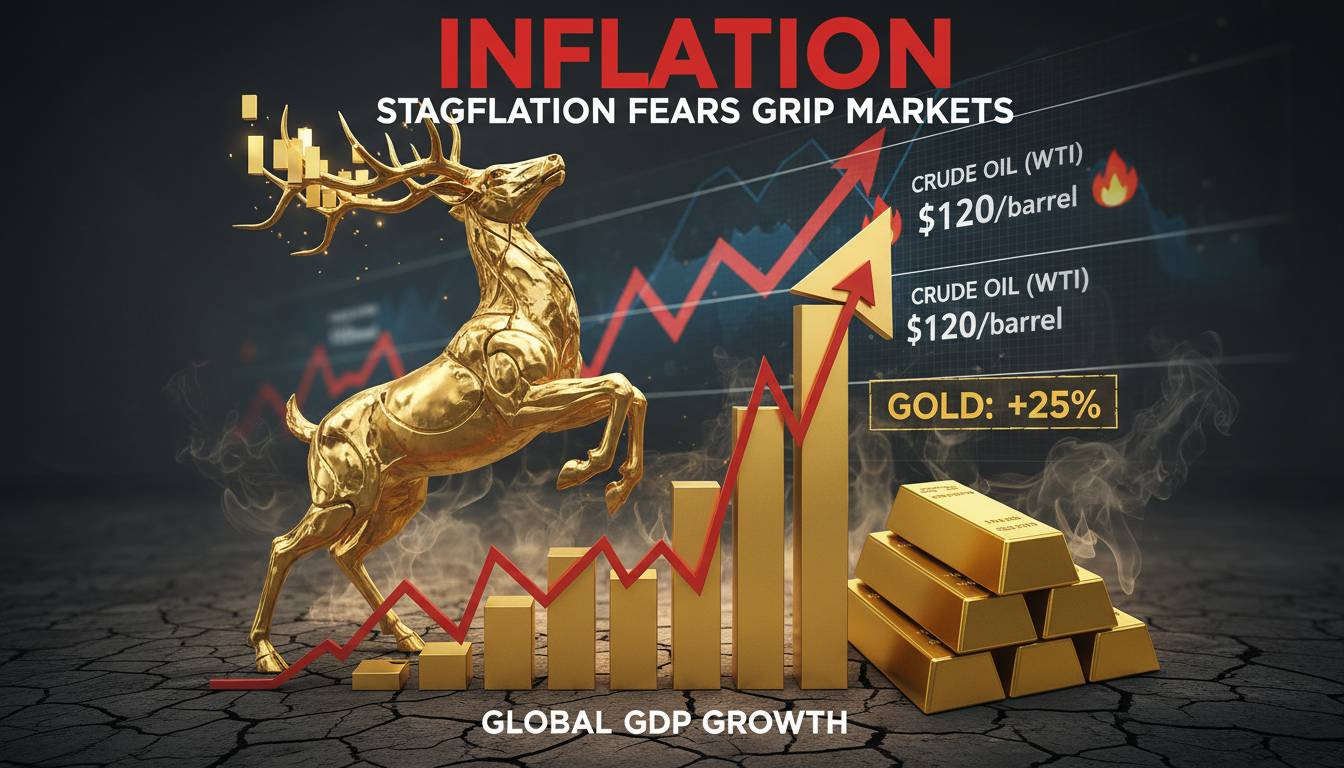
Gold is extending its 2026 advance while oil prices are easing and Bitcoin is holding up as a parallel macro hedge, creating a cross-asset pattern that looks closer to a stagflation trade than a simple risk-on rally. As of March 25, 2026, the setup matters because investors are weighing slower U.S. growth, still-elevated inflation expectations, and diverging signals from commodities, safe havens, and digital assets.
On March 25, 2026, gold remained near record territory above the $4,500-per-ounce area, oil benchmarks were trading below the early-March spike, and Bitcoin was changing hands near the upper-$60,000 range, according to LBMA-linked market data, EIA oil data, and CoinGecko pricing snapshots. The immediate macro backdrop is a softer U.S. growth path paired with inflation that remains above the Federal Reserve’s 2% target, after the Fed’s March 19, 2026 projections showed 2025 growth at 1.7% and inflation at 2.7%.
💡
The macro split is the story.
Gold is behaving like a classic policy-and-inflation hedge, oil is retreating on supply and inventory expectations, and Bitcoin is trading as a scarce alternative asset rather than simply following crude. Sources: Federal Reserve-linked reporting, EIA outlook, LBMA, CoinGecko; checked March 25, 2026.
Cross-Asset Snapshot on March 25, 2026
| Asset | Latest referenced level | Context |
|---|---|---|
| Gold | Above $4,500/oz area | LBMA 2026 survey pages describe gold rebounding above $4,500 after the late-2025 sell-off |
| WTI crude | Low-$70s to upper-$70s range in official and market references | EIA weekly and outlook material show 2026 prices below the early-March shock highs |
| Bitcoin | About $68,796 | CoinGecko BTC/USD snapshot for early March 2026 shows BTC near $68.8K |
| U.S. CPI | 2.4% y/y in February 2026 | BLS national CPI release dated March 11, 2026 |
Source: LBMA, EIA, CoinGecko, BLS | Verified from pages available as of March 25, 2026
How to invest during a period of quasi-stagflation? Our APAC equity strategist Sunil Koul shared strategies on @BloombergTV today: https://t.co/lb7iy1oRoV pic.twitter.com/OeLm98M7Rz
— Goldman Sachs (@GoldmanSachs) April 8, 2022
March 19 Fed Projections Put 1.7% Growth Against 2.7% Inflation
The strongest factual anchor for the “stagflation 2.0” framing is not a market slogan but the Fed’s own downgraded economic path. Reporting on the March 19, 2026 Federal Open Market Committee meeting shows officials cut their 2025 growth forecast to 1.7% from 2.1% and lifted their inflation projection to 2.7%. That combination does not equal 1970s-style stagflation, but it does describe slower growth with inflation still running above target.
At the same time, the latest hard inflation print is not accelerating sharply. The Bureau of Labor Statistics said on March 11, 2026 that the U.S. CPI rose 0.3% month over month in February and 2.4% year over year, while core CPI rose 0.2% on the month and 2.5% on the year. The next CPI release, for March 2026, is scheduled for April 10, 2026, which means markets on March 25 are still trading on February inflation data plus forward-looking energy and policy expectations.
That gap between backward-looking inflation data and forward-looking macro fear helps explain the asset split. Gold tends to respond to policy credibility, real yields, and hedging demand. Bitcoin often responds to liquidity expectations and scarcity narratives. Oil, by comparison, can fall even in an inflation-sensitive environment if traders start focusing on supply growth and inventory builds instead of immediate geopolitical risk.
Gold vs Oil: Why the Divergence Matters in March 2026
Gold’s strength and oil’s pullback are not contradictory. They point to different parts of the macro equation. The EIA’s Short-Term Energy Outlook says growing global oil production is expected to drive inventory builds and push crude prices lower through 2026. That is a supply-side explanation for softer oil, even while broader investors remain uneasy about inflation, debt, and policy uncertainty.
— Hashrate Index 🟧⛏️ (@hashrateindex) March 11, 2026
Gold, on the other hand, is being supported by a wider set of drivers. LBMA’s 2026 analyst survey says gold rebounded above $4,500 an ounce after the late-2025 sell-off, and multiple contributors cite geopolitical risk, de-dollarization, fiscal deficits, and monetary-policy uncertainty as reasons investors continue to hold the metal. LBMA also said the actual average gold price in 2025 reached $3,431.54, far above the prior survey average, showing how quickly the gold market repriced over the past year.
How the 2026 Macro Trade Developed
March 11, 2026: BLS reports U.S. CPI at 2.4% year over year for February, with core CPI at 2.5%.
The Fed’s 2026 severely adverse scenario warns of a 54% stock market crash triggered by an “abrupt decline in risk appetite” — think AI bubble burst and negative wealth shock.
Even the baseline outlook is muted: just 4.3% annual equity growth for the S&P 500 through 2029, barely…
— Seeking Alpha (@SeekingAlpha) February 26, 2026
March 13, 2026: BEA releases January 2026 personal income and outlays data; February PCE is not due until April 9, leaving markets without a fresh PCE update on March 25.
March 19, 2026: Fed-linked reporting shows downgraded 2025 growth to 1.7% and inflation at 2.7%, sharpening stagflation concerns.
March 25, 2026: Gold stays elevated, oil remains off its shock highs, and Bitcoin trades near the upper-$60,000 range.
Historically, that mix is important because gold and oil often rise together during pure inflation shocks. When gold rises while oil fades, the market is usually expressing a more nuanced message: concern about policy error, growth fragility, or financial hedging demand rather than a straightforward commodity boom. That is why the current divergence deserves attention beyond a one-day price move.
How Bitcoin Filled the Gap Near $68,800
Bitcoin’s role in this setup is more specific than “digital gold,” but the comparison is no longer fringe. CoinGecko’s BTC/USD page shows Bitcoin around $68,796 in early March 2026, after a seven-day range that ran from roughly $64,074 to $68,796. That places BTC well above the February lows shown on the same page, even though macro uncertainty has not disappeared.
The reason Bitcoin “fills the gap” is that it can absorb flows from investors who want inflation-sensitive upside without direct exposure to oil’s supply cycle. It also offers a liquid, globally traded alternative when gold is already extended. That does not make Bitcoin a perfect hedge. It remains more volatile than bullion and can still trade like a risk asset during sharp deleveraging. But in a market where oil is slipping and gold is expensive, Bitcoin can become the marginal macro expression for investors seeking scarcity exposure. This is an inference from the price behavior and macro backdrop, not a direct statement from any single source.
Why Each Asset Is Moving Differently
| Asset | Main driver | Why it matters now |
|---|---|---|
| Gold | Safe-haven demand, policy uncertainty, reserve diversification | Benefits from slower growth and above-target inflation |
| Oil | Supply growth and inventory expectations | Can fall even when inflation fears persist |
| Bitcoin | Scarcity trade, macro hedge demand, liquidity sensitivity | Acts as a high-beta alternative to gold when crude weakens |
Source: LBMA, EIA, CoinGecko | March 2026 references
What 2 Scheduled Data Dates Could Reset the Trade
Two calendar points matter more than day-to-day commentary. First, the BEA is scheduled to release February 2026 Personal Income and Outlays, including PCE inflation, on April 9, 2026. Second, BLS is scheduled to release March 2026 CPI on April 10, 2026. Those reports will test whether the market’s stagflation concern is being confirmed by fresh inflation data or whether the fear is running ahead of the numbers.
If inflation stays sticky while growth indicators soften, gold’s bid has a clear macro foundation and Bitcoin may continue to attract alternative-hedge flows. If inflation cools faster and oil remains soft, the trade could shift from stagflation hedging toward a more conventional disinflation setup. For now, the verified data support one narrow conclusion: as of March 25, 2026, gold is stronger than oil, and Bitcoin is behaving more like a macro scarcity asset than an energy-linked risk trade.
Frequently Asked Questions
Is the U.S. in stagflation on March 25, 2026?
Not by official declaration. But the concern is grounded in data: Fed-linked reporting on March 19, 2026 showed 2025 growth projected at 1.7% and inflation at 2.7%, while BLS reported February CPI at 2.4% year over year on March 11, 2026. That combination supports a stagflation-style market narrative.
Why is gold rising if oil is falling?
Because the drivers differ. EIA says growing global oil production and inventory builds are expected to pressure crude through 2026, while LBMA survey material points to gold support from geopolitical risk, fiscal concerns, reserve diversification, and monetary uncertainty. Gold is trading policy risk; oil is trading supply.
What is Bitcoin’s role in this market setup?
Bitcoin is acting as a scarce, liquid macro asset. CoinGecko pricing shows BTC near $68,796 in early March 2026, above the week’s low near $64,074. In this environment, some investors may prefer BTC exposure when gold is already elevated and oil is weakening.
What inflation data are markets waiting for next?
The next major U.S. inflation dates are April 9, 2026 for BEA’s February 2026 PCE release and April 10, 2026 for BLS’s March 2026 CPI release. Those reports will be the next hard tests of whether inflation is cooling or staying sticky.
Does softer oil mean inflation risk is over?
No. Lower crude can ease headline inflation pressure, but it does not remove broader concerns around services inflation, fiscal deficits, or policy credibility. That is why gold can stay firm even when oil retreats, and why markets are still focused on upcoming CPI and PCE releases.
Disclaimer: This article is for informational purposes only and does not constitute financial or investment advice. Cryptocurrency investments carry significant risk, including the possibility of total loss. Always conduct your own research and consult a qualified financial advisor before making investment decisions.

Cynthia Turner is a seasoned financial journalist with over 4-7 years of experience in the industry, specializing in YMYL content including finance and cryptocurrency. She holds a BA/BS from a reputable university and has been actively contributing to The Weal for the past 3-5 years. Cynthia's passion for delivering accurate and insightful analysis makes her a trusted source in the field.In her role, she has covered various topics related to personal finance, market trends, and investment strategies. Cynthia is committed to ensuring her readers are well-informed and equipped to make sound financial decisions.For inquiries, please reach out via email: cynthia-turner@tlt.ng. Disclosure: The views expressed in her articles are her own and do not necessarily represent the views of her employer.