News
Ethereum 2029 Strawmap: 7 Hard Forks Against Quantum Threats
Discover how Ethereum unveils 2029 Strawmap with 7 hard forks to counter quantum threats, boost security, and protect the network. Read more ✓

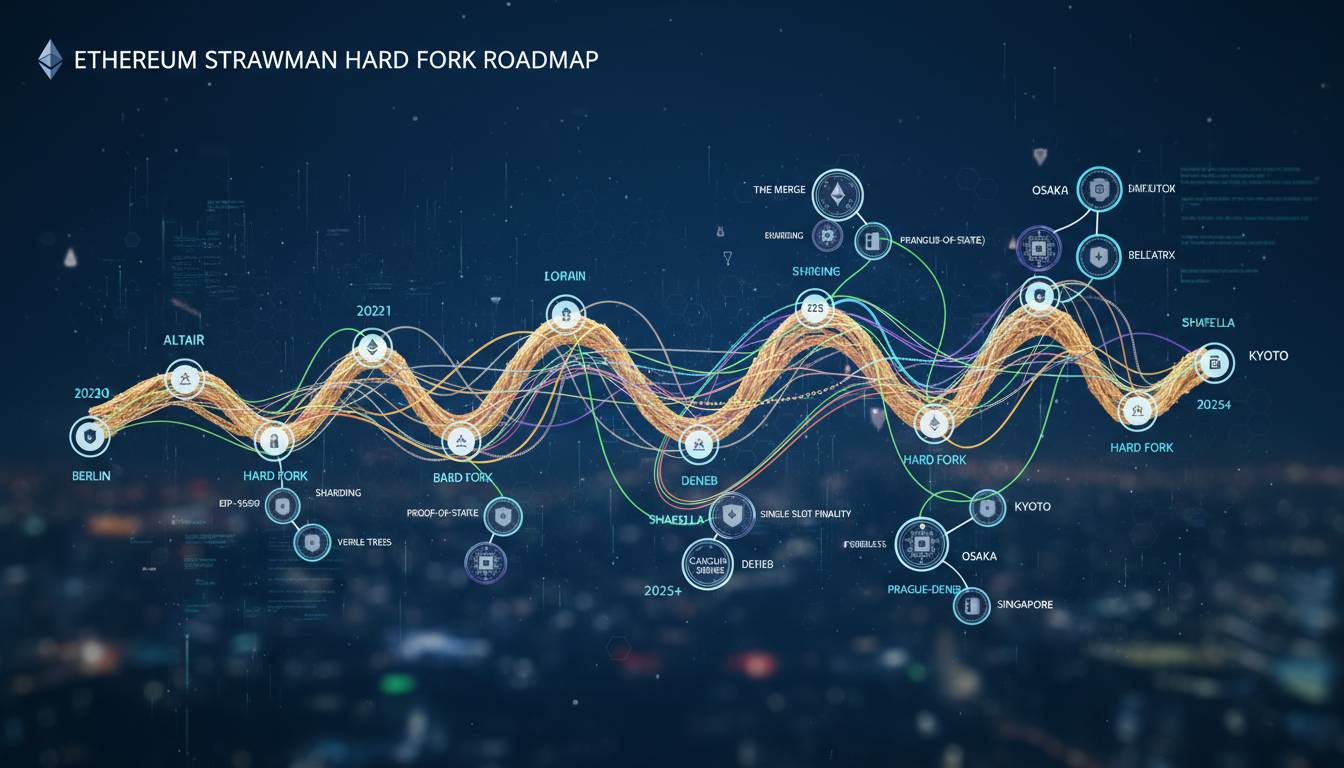
Ethereum’s core researchers have outlined a draft “strawmap” running through 2029 that sketches seven hard forks, faster finality, higher data throughput, native privacy, and post-quantum security work. The plan surfaced in late February 2026 and matters because Ethereum is trying to upgrade long-term security before quantum computing becomes a practical threat to today’s wallet cryptography, according to Ethereum ecosystem materials and multiple industry reports.
At publication on March 25, 2026, Ether trades at $2,170.58, with an intraday range of $2,104.52 to $2,196.97, according to market data. That price action is not the story here. The bigger development is protocol direction: Ethereum’s architecture team has circulated a long-range draft that groups upgrades into roughly seven forks over about four years, or near six-month intervals, with quantum resistance listed alongside fast finality, zk-enabled execution, privacy, and larger data availability as headline goals.
💡
The “strawmap” is a draft, not a finalized shipping calendar.
Reports describing the document say it was released as a living planning framework after an Ethereum Foundation workshop in January 2026, with quarterly updates possible rather than guaranteed mainnet dates.
Ethereum Strawmap: Reported Core Targets
| Target Area | Reported Focus | Why It Matters |
|---|---|---|
| Consensus | Faster finality, shorter block cadence | Lower latency for users and apps |
| Data availability | Much larger throughput for rollups | Supports cheaper L2 scaling |
| Execution | zk-assisted or zk-native verification path | Improves efficiency and verifiability |
| Security | Post-quantum signature migration | Reduces long-term cryptographic risk |
| Privacy | Native privacy features for ETH transfers | Expands user-level confidentiality options |
Source: Decrypt, KuCoin News, BSCN summaries of Ethereum Foundation roadmap reporting | accessed March 25, 2026
7 Planned Forks Through 2029 Frame Ethereum’s Security Push
The reported structure is notable less for exact fork names than for cadence and scope. Decrypt reported that Ethereum researchers drafted seven hard forks through 2029, while other coverage tied the plan to five “north star” goals: post-quantum Layer 1 security, fast finality, zk-L1 execution, native privacy, and teragas-scale data availability.
Introducing strawmap, a strawman roadmap by EF Protocol.
Believe in something. Believe in an Ethereum strawmap.
Who is this for?
The document, available at strawmap[.]org, is intended for advanced readers. It is a dense and technical resource primarily for researchers,… pic.twitter.com/gIZh5I8Not
— Justin Drake (@drakefjustin) February 25, 2026
That matters because Ethereum’s upgrade history has usually been discussed one fork at a time. This draft instead gives developers, rollup teams, wallet makers, and infrastructure operators a multi-year sequence. By comparison with shorter upgrade cycles in prior years, a four-year map gives more time for client implementation, audits, and coordination, especially for cryptographic changes that affect wallets and validators. The roadmap is still provisional, but the sequencing itself is a signal that Ethereum wants to tackle security and performance together rather than as separate tracks.
Timeline of the 2029 Strawmap Story
January 2026: Ethereum Foundation workshop reportedly shapes the draft roadmap framework.
Ethereum is for quantum resistance. https://t.co/XEZHicChpz
— Ethereum (@ethereum) January 26, 2026
February 25-26, 2026: Public reporting begins to describe a seven-fork strawmap extending to 2029.
March 2026: Broader market coverage highlights post-quantum security as one of the roadmap’s headline goals.
Why Quantum Risk Is Driving Ethereum’s 2026-2029 Design
Ethereum’s own security materials already frame quantum computing as a long-term but real protocol risk. The ethereum.org “Future-proofing Ethereum” page says quantum computers are probably decades away from becoming a genuine threat, but it also states Ethereum is being built to remain secure for centuries. Separately, the Trillion Dollar Security report warns that Ethereum’s core cryptography, including elliptic-curve signatures such as secp256k1, could eventually be broken by quantum computers.
— Four Pillars (@FourPillarsFP) August 4, 2025
That distinction is important. The strawmap is not evidence of an imminent quantum break. It is evidence that Ethereum researchers want migration paths ready before the threat becomes urgent. In practice, the hardest part is not only choosing a quantum-resistant scheme. It is moving hundreds of billions of dollars in assets, millions of accounts, validator keys, smart contract assumptions, and wallet software onto new cryptographic rails without breaking usability.
There is already at least one concrete sign of this direction in Ethereum’s standards process. EIP-7619 proposes a Falcon-512 verifier precompile and explicitly states that quantum computing threatens blockchain systems using non-quantum-resistant algorithms. That does not mean Falcon-512 is the final answer for Ethereum mainnet, but it shows post-quantum design work is already moving through public technical channels rather than staying theoretical.
⚠️
Quantum migration is a wallet and validator problem as much as a protocol problem.
Ethereum’s security documents focus on the risk to existing elliptic-curve cryptography, which means any eventual transition would affect signing keys, account recovery, and staking operations, not just block production rules.
How Fast Finality and zk-L1 Work Sit Beside Post-Quantum Goals
The strawmap is broader than quantum defense. Reports say it also targets near-instant or much faster finality, shorter slot or block timing, and a zk-heavy execution path. Those pieces fit together. Faster finality improves user experience and settlement confidence. Larger data availability supports rollups, which remain Ethereum’s main scaling path. zk verification can reduce trust assumptions and improve proving efficiency over time.
In market context, Ethereum remains the dominant smart-contract settlement layer by total value locked. A March 2026 market report cited Ethereum TVL at $54.19 billion, ahead of Solana at $6.54 billion and BNB Chain at $5.75 billion. That gap helps explain why Ethereum researchers are planning for security decades ahead: the network already secures a much larger economic base than most peers, so cryptographic debt compounds over time.
Ethereum’s Position in Market Context
| Metric | Ethereum | Context |
|---|---|---|
| ETH spot price | $2,170.58 | March 25, 2026 market snapshot |
| Intraday range | $2,104.52-$2,196.97 | Same-day volatility band |
| TVL | $54.19 billion | Leads major smart-contract chains in cited March 2026 report |
| Historical close | $2,053.19 on Feb. 25, 2026 | CoinGecko historical data point one month earlier |
Source: finance tool, CoinGecko historical data, ChainCatcher market report | March 25, 2026
What March 2026 Means for Wallets, Rollups, and Ethereum Governance
For users, the immediate takeaway is limited: no seven-fork schedule has been finalized as binding governance. For builders, the takeaway is larger. Wallet providers may need to prepare for hybrid or replacement signature schemes. Rollup teams may need to align with higher data throughput assumptions. Client teams may need to budget engineering resources across consensus, execution, and cryptography at the same time.
The governance angle also matters. The term “strawmap” itself signals a draft rather than a decree. BSCN’s summary of the document says the name combines “strawman” and “roadmap,” reflecting that Ethereum has no single authority imposing a final plan across all stakeholders. That is consistent with Ethereum’s upgrade culture, where research, client implementation, community review, and social consensus all shape what actually ships.
So the headline is not that Ethereum has solved quantum risk. It has not. The headline is that by March 2026, Ethereum researchers are publicly sequencing a multi-fork path that treats post-quantum security as a first-order protocol objective rather than a distant footnote. That is a meaningful shift in planning discipline for the largest programmable blockchain by economic activity.
Frequently Asked Questions
What is Ethereum’s 2029 “strawmap”?
It is a draft long-range protocol roadmap described in public reporting in late February 2026. Multiple reports say it outlines roughly seven hard forks through 2029 and groups work around fast finality, data scaling, zk-L1 execution, native privacy, and post-quantum security.
Has Ethereum confirmed seven hard forks on fixed dates?
No fixed mainnet dates were confirmed in the sources reviewed. Coverage describes the plan as a draft or living document that emerged after a January 2026 workshop, which means the cadence is directional rather than a finalized release calendar as of March 25, 2026.
Why is Ethereum focusing on quantum threats now?
Ethereum’s own documentation says quantum computers are probably decades away from becoming a genuine threat, but it also warns that existing elliptic-curve cryptography could eventually be broken. The strategy appears to be early preparation, since migrating wallets, validators, and applications would take years.
Does the strawmap only concern quantum resistance?
No. The reported roadmap is broader. It also includes faster finality, larger data availability for rollups, zk-related execution improvements, and privacy features. Quantum resistance is one pillar, not the only one.
What is one concrete post-quantum sign in Ethereum’s public pipeline?
EIP-7619, a proposal for a Falcon-512 verifier precompile, explicitly discusses the threat quantum computing poses to non-quantum-resistant cryptography. It is not proof of final adoption, but it shows post-quantum work is already present in Ethereum’s public standards process.
Disclaimer: This article is for informational purposes only. Information may have changed since publication. Always verify information independently and consult qualified professionals for specific advice.

Cynthia Turner is a seasoned financial journalist with over 4-7 years of experience in the industry, specializing in YMYL content including finance and cryptocurrency. She holds a BA/BS from a reputable university and has been actively contributing to The Weal for the past 3-5 years. Cynthia's passion for delivering accurate and insightful analysis makes her a trusted source in the field.In her role, she has covered various topics related to personal finance, market trends, and investment strategies. Cynthia is committed to ensuring her readers are well-informed and equipped to make sound financial decisions.For inquiries, please reach out via email: cynthia-turner@tlt.ng. Disclosure: The views expressed in her articles are her own and do not necessarily represent the views of her employer.