News
Gold Price Analysis: Crypto Decoupling From Safe-Haven Trends
Explore Gold Price Analysis and crypto decoupling from safe-haven trends. Get clear market insights, key signals, and expert perspective for smarter decisions.

Gold’s safe-haven bid has stayed firm into March 24, 2026, while Bitcoin has traded more like a risk-sensitive asset than a crisis hedge. That divergence matters for U.S. investors comparing inflation protection, liquidity, ETF flows, and macro sensitivity. Data from the World Gold Council, CME Group, Glassnode research, and ETF flow trackers show gold demand has remained anchored by official-sector buying and ETF accumulation, while Bitcoin’s behavior has been shaped more by derivatives positioning and spot ETF flow swings.
💡
The core split is demand quality.
World Gold Council data published January 29, 2026 shows U.S. gold demand rose 140% year over year to 679 tonnes in 2025, with 437 tonnes coming from U.S. gold-backed ETFs. By contrast, Bitcoin’s early-2026 narrative has been dominated by alternating ETF inflows and outflows and elevated options hedging activity, according to World Gold Council, Farside-linked flow reporting, and CME Group data.
2025 Gold ETF Surge Signals a Different Kind of Shelter
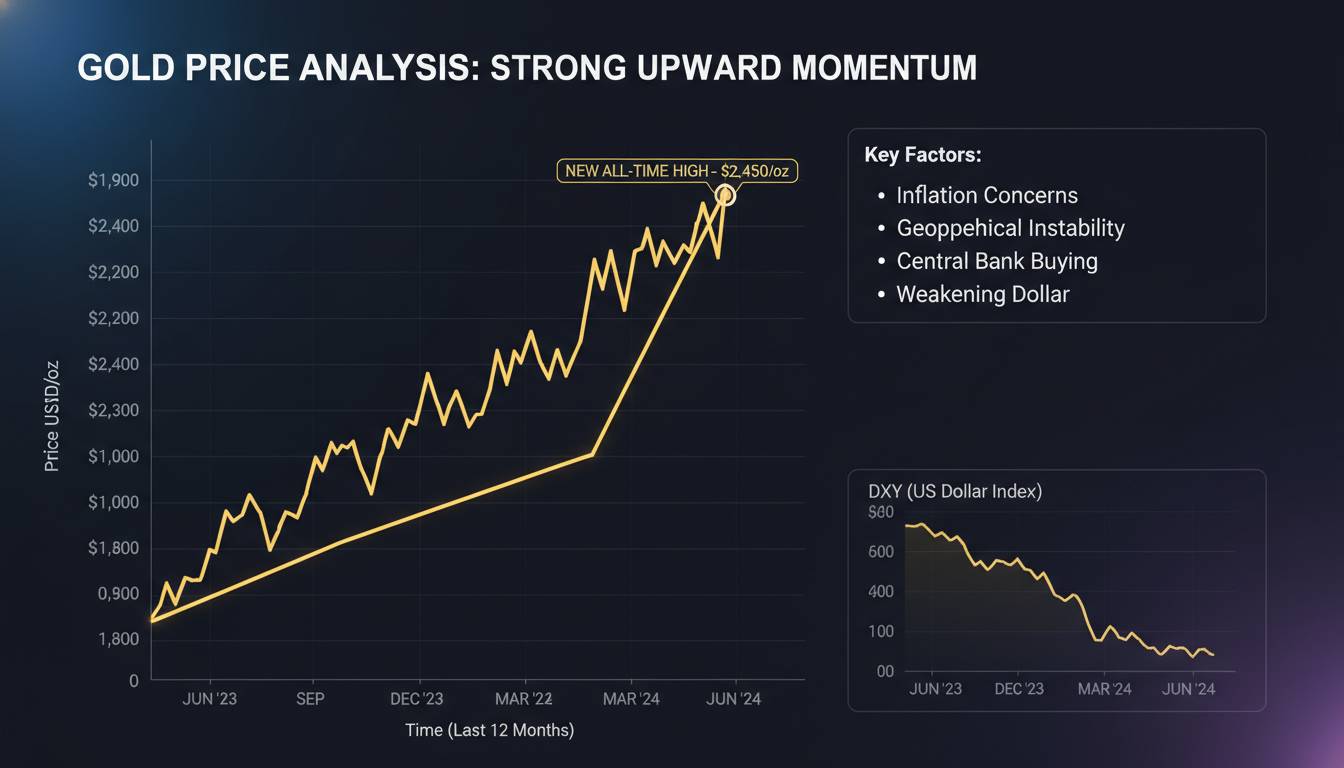
Gold entered 2026 with unusually strong institutional support. The World Gold Council said on January 29, 2026 that U.S. gold demand reached 679 tonnes in 2025, the highest since 2020, and that U.S. gold-backed ETFs attracted 437 tonnes, pushing holdings to a record 2,019 tonnes and about $280 billion in assets under management. The same report said the LBMA PM gold price set 53 all-time highs during 2025, with an average fourth-quarter price of $4,135 an ounce and a full-year average of $3,431, up 44% year over year.
That matters because gold’s rally was not driven by one speculative pocket. World Gold Council data for full-year 2025 shows global physically backed gold ETFs climbed to a record 4,025 tonnes, while annual inflows reached a record $89 billion. The council also reported that central banks added 863 tonnes in 2025, extending a multi-year pattern of official-sector accumulation. In market terms, that is broad-based demand: reserve managers, ETF investors, and retail bar-and-coin buyers all contributed, even as jewelry demand softened under higher prices.
Gold Demand Markers Cited in the Safe-Haven Debate
| Metric | Value | Why It Matters |
|---|---|---|
| U.S. gold demand in 2025 | 679 tonnes | Highest since 2020, per World Gold Council |
| U.S. gold ETF demand in 2025 | 437 tonnes | Shows institutional and portfolio demand |
| Global gold ETF holdings in 2025 | 4,025 tonnes | Record level of physically backed holdings |
| Central bank gold buying in 2025 | 863 tonnes | Official-sector support for reserve diversification |
Source: World Gold Council reports published January 29, 2026 and full-year 2025 demand releases
Gold’s safe-haven profile also differs from crypto because its buyers are often less price-sensitive and less leveraged. World Gold Council’s 2026 outlook says geopolitics, lower-rate expectations, and dollar pressure are likely to support another year of strong gold ETF inflows. That is a slower but more stable transmission mechanism than the one seen in crypto markets, where positioning can reverse within days.
Why Bitcoin’s 2026 Tape Looks Less Like Gold and More Like Risk
Bitcoin still attracts “digital gold” comparisons, but the trading evidence in early 2026 points elsewhere. CME Group said on February 19, 2026 that year-to-date average daily volume in its cryptocurrency futures and options reached 407,200 contracts, up 46% year over year, while average daily open interest rose to 335,400 contracts, up 7%. That is a sign of deep institutional participation, but not necessarily of safe-haven behavior.
📊 Gold up 65%. Silver up 148%. Bitcoin? Flat.
History says crypto follows metals with a lag. When profit-taking hits gold and silver, capital rotates, and the gap closes.
Is BTC about to play catch-up?
Full analysis ⬇️ https://t.co/jbEOflTX6V— BSCN (@BSCNews) January 29, 2026
CME’s March 2026 options commentary adds more detail. It said March Bitcoin expirations carried roughly a 3:1 call-to-put open-interest ratio, with about $660 million in calls against $240 million in puts. At the same time, implied volatility during the February selloff reached the highest levels since 2022, and put open interest clustered around $60,000 and $80,000 strikes. In plain terms, traders were paying up for downside protection while also keeping upside optionality alive.
Glassnode’s February 25, 2026 market note described Bitcoin as range-bound between $60,000 and $70,000, about 47% below its all-time high. The firm said that drawdown depth historically aligns more with mid-to-late bear-market phases than with classic defensive-asset behavior. It also warned that sustained compression at those levels raises the risk of stress among leveraged or structurally weak holders.
Bitcoin’s Early-2026 Positioning Timeline
February 5, 2026: CME data cited implied volatility near 2022 highs during the sharp selloff, with downside hedging demand elevated.
🚨 New Publication!
Hedging, safe-haven & diversification roles of #cryptos vs. #gold under inflationary pressure.
By Maria Gonzalez, Francisco Jareño & M Caridad Sevillano https://t.co/cbwrhvsK83@uclm_es @UCLMdivulga @BibliotecaUCLM @ftaadcee_ab @CijabUclm @SomosGlobalcaja— Fran Jareño (@Fran_Jareno) October 16, 2025
February 25, 2026: Glassnode said Bitcoin was trading in a $60,000-$70,000 range and remained 47% below its peak.
March 10, 2026: SoSoValue-linked reporting showed U.S. spot Bitcoin ETFs recorded a $251 million net inflow for the day after earlier outflow pressure.
ETF flow behavior reinforces the point. Publicly circulated March 2026 flow reports tied to SoSoValue and Farside-tracked data show Bitcoin ETF demand has been inconsistent, with some sessions posting strong inflows and others sharp redemptions. That pattern is very different from the broad 2025 gold ETF accumulation cycle, where holdings rose across regions and remained tied to macro hedging demand.
Gold vs Bitcoin: Which Asset Is Acting Like a Haven?
The answer depends on the definition. If a safe haven is an asset that attracts capital during geopolitical stress, reserve diversification, and equity volatility, gold has the stronger case. World Gold Council data shows more than half of the increase in global annual ETF demand in 2025 went into North American funds, while Asian funds also posted major gains. The council explicitly linked those flows to geopolitical risk, rate-cut expectations, and concern over equity-market volatility.
Bitcoin’s pattern is narrower. An academic paper posted to arXiv in late 2025 found that after U.S. spot Bitcoin ETF approval in January 2024, Bitcoin’s correlation with the S&P 500 increased while its relationship with gold stabilized near zero. That does not prove permanent decoupling, but it supports the idea that Bitcoin has become more integrated with broader risk markets as institutional access has expanded.
Comparison: Gold and Bitcoin in the Safe-Haven Test
| Factor | Gold | Bitcoin |
|---|---|---|
| 2025 ETF trend | Record global inflows and holdings | Mixed daily flows in early 2026 |
| Official-sector demand | 863 tonnes bought by central banks | None comparable |
| Volatility profile | Lower, macro-driven | Higher, derivatives-sensitive |
| Correlation signal | Traditional haven behavior | Near-zero to gold, higher equity linkage |
Source: World Gold Council, CME Group, Glassnode, arXiv research, data published through March 2026
There is still a counterpoint. Bitcoin remains scarce, globally traded, and outside sovereign balance sheets. In some episodes, that can support a hedge narrative. But the weight of verified 2025 and early-2026 data shows that gold’s demand base is broader, less leveraged, and more directly tied to classic haven motives.
3 Paths as Macro Stress Tests the Haven Narrative
One path is continued divergence. If geopolitical risk stays elevated and rate-cut expectations build, gold could keep drawing ETF and reserve demand, especially after the record 2025 inflow year. A second path is partial reconvergence, where Bitcoin benefits from easier financial conditions and renewed ETF inflows, but that would still look more like liquidity-driven upside than defensive buying. A third path is broad risk-off selling, where Bitcoin falls with equities while gold holds or rises, which would deepen the decoupling argument.
📊
Decoupling does not mean Bitcoin loses relevance.
It means investors may need to classify it differently. Gold’s 2025 demand came from ETFs, central banks, and long-horizon allocators. Bitcoin’s early-2026 behavior has been more dependent on derivatives, ETF flow momentum, and broader risk appetite, based on World Gold Council, CME Group, and Glassnode data.
Frequently Asked Questions
Is Bitcoin still considered digital gold in 2026?
It is still described that way by some market participants, but verified market data through March 2026 shows Bitcoin has traded more like a risk asset than a classic haven. CME and Glassnode data point to high volatility, heavy derivatives influence, and price behavior that differs from gold’s steadier macro-hedge demand.
Why does gold look stronger than crypto as a safe haven?
Gold’s support comes from several buyer groups at once. The World Gold Council said U.S. gold demand hit 679 tonnes in 2025, with 437 tonnes from U.S. ETFs, while central banks added 863 tonnes globally. That mix is broader and typically more stable than crypto’s flow-driven demand.
Do Bitcoin ETF inflows prove safe-haven demand?
Not by themselves. Bitcoin ETF inflows can reflect tactical buying, momentum chasing, or portfolio rebalancing. March 2026 flow reports showed both strong inflow days and notable outflow sessions, which suggests sensitivity to market sentiment rather than the persistent accumulation pattern seen in gold ETFs during 2025.
Has Bitcoin fully decoupled from gold?
No single metric proves full decoupling. But available research and market data indicate Bitcoin’s correlation with gold has stayed near zero while its linkage to broader risk markets has increased after spot ETF approval. That supports a functional decoupling in behavior, even if narratives still overlap.
What should investors watch next in this comparison?
The most important signals are gold ETF holdings, central-bank reserve data, Bitcoin spot ETF flows, and derivatives positioning around major macro events. If gold keeps attracting strategic inflows while Bitcoin reacts mainly to liquidity and leverage, the haven split becomes harder to dismiss.
Disclaimer: This article is for informational purposes only and does not constitute financial or investment advice. Cryptocurrency investments carry significant risk, including the possibility of total loss. Always conduct your own research and consult a qualified financial advisor before making investment decisions.

Debra Phillips is a seasoned general expert with over 13 years of professional experience. Debra specializes in content strategy, digital media, and audience engagement, bringing deep industry knowledge and practical insights to every piece of content.With credentials including Professional Journalist Certification and Bachelor's Degree in Communications, Debra has established a reputation for delivering accurate, well-researched, and actionable information. Debra's work has been featured in leading general publications and trusted by thousands of readers seeking reliable expertise.Debra is committed to maintaining the highest standards of accuracy and transparency, ensuring all content is thoroughly fact-checked and based on credible sources and current industry best practices. Connect: Twitter | LinkedIn | Website